The unicorn is a legendary creature that has been described since antiquity as a beast with a single large, pointed, spiraling horn projecting from its forehead. The unicorn was depicted in ancient seals of the Indus Valley Civilization and was mentioned by the ancient Greeks in accounts of natural history by various writers, including Ctesias, Strabo, Pliny the Younger, and Aelian.[1] The Bible also describes an animal, the re'em, which some versions translate as unicorn.[1]
In European folklore, the unicorn is often depicted as a white horse-like or goat-like animal with a long horn and cloven hooves (sometimes a goat's beard). In the Middle Ages and Renaissance, it was commonly described as an extremely wild woodland creature, a symbol of purity and grace, which could be captured only by a virgin. In the encyclopedias, its horn was said to have the power to render poisoned water potable and to heal sickness. In medieval and Renaissance times, the tusk of the narwhal was sometimes sold as unicorn horn.
In antiquity
Unicorns are not found in Greek mythology, but rather in the accounts of natural history, for Greek writers of natural history were convinced of the reality of unicorns, which they believed lived in India, a distant and fabulous realm for them. The earliest description is from Ctesias, who in his book Indika ("On India") described them as wild asses, fleet of foot, having a horn a cubit and a half (700 mm, 28 inches) in length, and colored white, red and black.[2] Aristotle must be following Ctesias when he mentions two one-horned animals, the oryx (a kind of antelope) and the so-called "Indian ass".[3][4] Strabo says that in the Caucasus there were one-horned horses with stag-like heads.[5] Pliny the Elder mentions the oryx and an Indian ox (perhaps a rhinoceros) as one-horned beasts, as well as "a very fierce animal called the monoceros which has the head of the stag, the feet of the elephant, and the tail of the boar, while the rest of the body is like that of the horse; it makes a deep lowing noise, and has a single black horn, which projects from the middle of its forehead, two cubits [900 mm, 35 inches] in length."[6] In On the Nature of Animals (Περὶ Ζῴων Ἰδιότητος, De natura animalium), Aelian, quoting Ctesias, adds that India produces also a one-horned horse (iii. 41; iv. 52),[7][8] and says (xvi. 20)[9] that the monoceros (Greek: μονόκερως) was sometimes called cartazonos (Greek: καρτάζωνος), which may be a form of the Arabic karkadann, meaning "rhinoceros".
Cosmas Indicopleustes, a merchant of Alexandria who lived in the 6th century, made a voyage to India and subsequently wrote works on cosmography. He gives a description of a unicorn based on four brass figures in the palace of the King of Ethiopia. He states, from report, that "it is impossible to take this ferocious beast alive; and that all its strength lies in its horn. When it finds itself pursued and in danger of capture, it throws itself from a precipice, and turns so aptly in falling, that it receives all the shock upon the horn, and so escapes safe and sound".[10][11]
A one-horned animal (which may be just a bull in profile) is found on some seals from the Indus Valley Civilization.[12] Seals with such a design are thought to be a mark of high social rank.[13]
Middle Ages and Renaissance

Virgin Mary holding the unicorn (c. 1480), detail of the Annunciation with the Unicorn Polyptych,
National Museum,
Warsaw
Medieval knowledge of the fabulous beast stemmed from biblical and ancient sources, and the creature was variously represented as a kind of wild ass, goat, or horse.
The predecessor of the medieval bestiary, compiled in Late Antiquity and known as Physiologus (Φυσιολόγος), popularized an elaborate allegory in which a unicorn, trapped by a maiden (representing the Virgin Mary), stood for the Incarnation. As soon as the unicorn sees her, it lays its head on her lap and falls asleep. This became a basic emblematic tag that underlies medieval notions of the unicorn, justifying its appearance in every form of religious art. Interpretations of the unicorn myth focus on the medieval lore of beguiled lovers,[citation needed] whereas some religious writers interpret the unicorn and its death as the Passion of Christ. The myths refer to a beast with one horn that can only be tamed by a virgin; subsequently, some writers translated this into an allegory for Christ's relationship with the Virgin Mary.
The unicorn also figured in courtly terms: for some 13th-century French authors such as Thibaut of Champagne and Richard de Fournival, the lover is attracted to his lady as the unicorn is to the virgin. With the rise of humanism, the unicorn also acquired more orthodox secular meanings, emblematic of chaste love and faithful marriage. It plays this role in Petrarch's Triumph of Chastity, and on the reverse of Piero della Francesca's portrait of Battista Strozzi, paired with that of her husband Federico da Montefeltro (painted c 1472-74), Bianca's triumphal car is drawn by a pair of unicorns.[14]
The Throne Chair of Denmark is made of "unicorn horns" – almost certainly narwhal tusks. The same material was used for ceremonial cups because the unicorn's horn continued to be believed to neutralize poison, following classical authors.
The unicorn, tamable only by a virgin woman, was well established in medieval lore by the time Marco Polo described them as "scarcely smaller than elephants. They have the hair of a buffalo and feet like an elephant's. They have a single large black horn in the middle of the forehead... They have a head like a wild boar's… They spend their time by preference wallowing in mud and slime. They are very ugly brutes to look at. They are not at all such as we describe them when we relate that they let themselves be captured by virgins, but clean contrary to our notions." It is clear that Marco Polo was describing a rhinoceros.[citation needed] In German, since the 16th century, Einhorn ("one-horn") has become a descriptor of the various species of rhinoceros.

A Unicorn of the 18th century on an apothecary in
Flensburg
Alicorn
The horn itself and the substance it was made of was called alicorn, and it was believed that the horn holds magical and medicinal properties. The Danish physician Ole Worm determined in 1638 that the alleged alicorns were the tusks of narwhals.[15] Such beliefs were examined wittily and at length in 1646 by Sir Thomas Browne in his Pseudodoxia Epidemica.[16]
False alicorn powder, made from the tusks of narwhals or horns of various animals, has been sold in Europe for medicinal purposes as late as 1741.[17] The alicorn was thought to cure many diseases and have the ability to detect poisons, and many physicians would make "cures" and sell them. Cups were made from alicorn for kings and given as a gift; these were usually made of ivory or walrus ivory. Entire horns were very precious in the Middle Ages and were often really the tusks of narwhals.[18]
Entrapment
One traditional method of hunting unicorns involved entrapment by a virgin.
In one of his notebooks Leonardo da Vinci wrote:
The unicorn, through its intemperance and not knowing how to control itself, for the love it bears to fair maidens forgets its ferocity and wildness; and laying aside all fear it will go up to a seated damsel and go to sleep in her lap, and thus the hunters take it.[19]
The famous late Gothic series of seven tapestry hangings The Hunt of the Unicorn are a high point in European tapestry manufacture, combining both secular and religious themes. The tapestries now hang in the Cloisters division of the Metropolitan Museum of Art in New York City. In the series, richly dressed noblemen, accompanied by huntsmen and hounds, pursue a unicorn against mille-fleur backgrounds or settings of buildings and gardens. They bring the animal to bay with the help of a maiden who traps it with her charms, appear to kill it, and bring it back to a castle; in the last and most famous panel, "The Unicorn in Captivity", the unicorn is shown alive again and happy, chained to a pomegranate tree surrounded by a fence, in a field of flowers. Scholars conjecture that the red stains on its flanks are not blood but rather the juice from pomegranates, which were a symbol of fertility. However, the true meaning of the mysterious resurrected unicorn in the last panel is unclear. The series was woven about 1500 in the Low Countries, probably Brussels or Liège, for an unknown patron. A set of six engravings on the same theme, treated rather differently, were engraved by the French artist Jean Duvetin the 1540s.
Another famous set of six tapestries of Dame à la licorne ("Lady with the unicorn") in the Musée de Cluny, Paris, were also woven in the Southern Netherlands before 1500, and show the five senses (the gateways to temptation) and finally Love ("A mon seul desir" the legend reads), with unicorns featured in each piece. Facsimiles of these unicorn tapestries were woven for permanent display in Stirling Castle, Scotland, to take the place of a set recorded in the castle in a 16th-century inventory.[20]
A rather rare, late-15th-century, variant depiction of the hortus conclusus in religious art combined the Annunciation to Mary with the themes of the Hunt of the Unicorn and Virgin and Unicorn, so popular in secular art. The unicorn already functioned as a symbol of the Incarnation and whether this meaning is intended in many prima facie secular depictions can be a difficult matter of scholarly interpretation. There is no such ambiguity in the scenes where the archangel Gabriel is shown blowing a horn, as hounds chase the unicorn into the Virgin's arms, and a little Christ Child descends on rays of light from God the Father. The Council of Trent finally banned this somewhat over-elaborated, if charming, depiction,[21] partly on the grounds of realism, as no one now believed the unicorn to be a real animal.
Shakespeare scholars describe unicorns being captured by a hunter standing in front of a tree, the unicorn goaded into charging; the hunter would step aside the last moment and the unicorn would embed its horn deeply into the tree (See annotations[22] of Timon of Athens, Act 4, scene 3, c. line 341: "wert thou the unicorn, pride and wrath would confound thee and make thine own self the conquest of thy fury".)
Heraldry
In heraldry, a unicorn is often depicted as a horse with a goat's cloven hooves and beard, a lion's tail, and a slender, spiral horn on its forehead[23] (non-equine attributes may be replaced with equine ones, as can be seen from the following gallery). Whether because it was an emblem of the Incarnation or of the fearsome animal passions of raw nature, the unicorn was not widely used in early heraldry, but became popular from the 15th century.[23] Though sometimes shown collared and chained, which may be taken as an indication that it has been tamed or tempered, it is more usually shown collared with a broken chain attached, showing that it has broken free from its bondage.
Scotland
In heraldry the unicorn is best known as the symbol of Scotland. The unicorn was chosen because it was seen as a proud and haughty beast which would rather die than be captured, just as Scots would fight to remain sovereign and unconquered.[24] Two unicorns supported the royal arms of the King of Scots, and since the 1707 union of England and Scotland, the royal arms of the United Kingdom have been supported by a unicorn along with an English lion. Two versions of the royal arms exist: that used in Scotland gives more emphasis to the Scottish elements, placing the unicorn on the left and giving it a crown, whereas the version used in England and elsewhere gives the English elements more prominence.
Golden coins known as the unicorn and half-unicorn, both with a unicorn on the obverse, were used in Scotland in the 15th and 16th century. In the same realm, carved unicorns were often used as finials on the pillars of Mercat crosses, and denoted that the settlement was a royal burgh. Certain noblemen such as the Earl of Kinnoull were given special permission to use the unicorn in their arms, as an augmentation of honour.[24] The crest for Clan Cunningham bears a unicorn head.[25]
Gallery
Unicorns as heraldic charges:
-
Arms of the Kruedener family
Unicorns as supporters:
-
Royal arms of Queen Elizabeth II as used in Scotland
-
Arms of the Dutch city of Hoorn with a single unicorn as a supporter
Possible origins
Hunts for an actual animal as the basis of the unicorn myth, accepting the conception of writers in Antiquity that it really existed somewhere at the edge of the known earth, have added a further layer of mythologizing about the unicorn. These have taken various forms, interpreted in a scientific, rather than a wonder-filled manner, to accord with modern perceptions of reality.
Fabricated evidence
Among numerous finds of prehistoric bones found at Unicorn Cave in Germany's Harz Mountains, some were selected and reconstructed by the mayor of Magdeburg, Otto Von Guericke, as a unicorn in 1663 (illustration, right). Guericke's so-called unicorn had only two legs, and was constructed from fossil bones of a woolly rhinocerosand a mammoth, with the horn of a narwhal. The skeleton was examined by Gottfried Leibniz, who had previously doubted the existence of the unicorn, but was convinced by it.[26]
Baron Georges Cuvier maintained that, as the unicorn was cloven-hoofed, it must therefore have a cloven skull (making the growth of a single horn impossible); as if to disprove this, Dr. W. Franklin Dove, a University of Maine professor, artificially fused the horn buds of a calf together, creating the external appearance of a one-horned bull.[27][dubious – discuss]
Unicorn seals of the Indus Valley Civilization
The first objects unearthed from Harappa and Mohenjo-Daro, major sites of the Indus Valley Civilization, were small stone seals inscribed with elegant depictions of animals, including a unicorn-like figure, and marked with Indus script writing which still baffles scholars. These seals are dated back to 2500 B.C.[28]
The "unicorn" figures on the seals have been interpreted as representations of aurochs—a type of large wild cattle that formerly inhabited Europe, Asia and North Africa—or derivatives of aurochs. It is suggested that as the animal is always shown in profile, only one of the two horns is seen.[29]
Elasmotherium or rhinoceros
One suggestion is that the unicorn is based on the extinct rhinocerus species Elasmotherium, a huge Eurasian mammal native to the steppes, south of the range of the woolly rhinoceros of Ice Age Europe. Elasmotherium looked little like a horse, but it had a large single horn in its forehead. It became extinct about the same time as the rest of the glacial age megafauna.[30]
However, according to the Nordisk familjebok (Nordic Familybook) and science writer Willy Ley the animal may have survived long enough to be remembered in the legends of the native European peoples as a huge black bull with a single horn in the forehead.
In support of this claim, it has been noted that the 13th century traveller Marco Polo claimed to have seen a unicorn in Java, but his description makes it clear to the modern reader that he actually saw a Javan rhinoceros.
More recent findings seem to place humans and the Siberian elasmotherium in the same area at the same time.[31] The fragmentary skull of an Elasmotherium sibiricum was found in Kazakhstan and carbon-dated in 2015 as ca. 30,000 years old.[32] Skulls of modern humans found in the same area date back up to 45,000 years, this meaning that our species and this type of mammal possibly coexisted in Western Siberia for thousands of years.[31]
Single-horned goat
The connection that is sometimes made with a single-horned goat derives from the vision of Daniel:
And as I was considering, behold, a he-goat came from the west over the face of the whole earth, and touched not the ground: and the goat had a notable horn between his eyes. (Daniel 8:5)
Neo-Pagan antiquities researcher Timothy Zell and his wife Morning Glory also produced artificial unicorns dubbed "the Living Unicorn", remodelling the "horn buds" of goat kids in such a way that their horns grew together into a single one.[33] Zell theorized that this process might have been used in the past to create court curiosities and natural herd leaders, because the goat was able to use this long straight horn effectively as a weapon and a tool. Medieval art often depicts unicorns as small, with cloven hooves and beards, sometimes resembling goats more than horses with horns. This process is possible only with animals that naturally have horns. For a time, a few of these unicorns travelled with the Ringling Brothers Circus.[34]
Narwhals
The unicorn horns often found in cabinets of curiosities and other contexts in Medieval and Renaissance Europe, were very often examples of the distinctive straight spiral single tusks of narwhals (Monodon monoceros), an Arctic cetacean, as Danish zoologist Ole Worm established in 1638.[35] They were brought south as a very valuable trade, and sold as horns from the legendary unicorn; being of ivory, they passed the various tests intended to spot fake unicorn horns.[36] As these 'horns' were considered to have magic powers, Vikings and other northern traders were able to sell them for many times their weight in gold. Elizabeth I of Englandkept a "unicorn horn" in her cabinet of curiosities, brought back by Arctic explorer Martin Frobisher on his return from Labrador in 1577.[37] The usual depiction of the spiral unicorn horn in art, derives from these.
The truth of the tusk's origin developed gradually during the Age of Exploration, as explorers and naturalists began to visit regions themselves. In 1555, Olaus Magnus published a drawing of a fish-like creature with a "horn" on its forehead.
Oryx
Oryx are antelopes with two long, thin horns projecting from its forehead. Some have suggested that seen from the side and from a distance, they look something like horses with single horns (although the 'horn' projects backward, not forward as in the classic unicorn). Conceivably, travellers in Arabia could have derived the tale of the unicorn from these animals. However, classical authors seem to distinguish clearly between oryxes and unicorns. The Peregrinatio in terram sanctam, published in 1486, was the first printed illustrated travel-book, describing a pilgrimage to Jerusalem, and thence to Egypt by way of Mount Sinai. It featured many large woodcuts by Erhard Reuwich, who went on the trip, mostly detailed and accurate views of cities. The book also contained pictures of animals seen on the journey, including a crocodile, camel, and unicorn—presumably an oryx, which they could easily have seen on their route.
Eland
In Southern Africa, the eland have somewhat mystical or spiritual connotations, perhaps at least partly because these very large antelopes will defend themselves against lions and are able to kill these fearsome predators. Eland are very frequently depicted in the rock art of the region, which implies they were viewed as having a strong connection to the other world, and in several languages the word for eland and for dance is the same; significant because shamans used dance as their means of drawing power from the other world. Eland fat was used when mixing the pigments for these pictographs, and in the preparation of many medicines.
This special regard for eland may well have been picked up by early travellers. There is a purported unicorn horn in the castle of the chief of the Clan MacLeod in Scotland, which has been identified as that of an eland.[citation needed]
Genetic disorders of horned or antlered animals
A new possibility for the inspiration of the unicorn came in 2008 with the discovery of a roe deer in Italy with a single antler. Single-antlered deer are not uncommon; however, the placement of the horn in the middle is very unusual. Fulvio Fraticelli, scientific director of Rome's zoo, has said "Generally, the horn is on one side (of the head) rather than being at the center. This looks like a complex case."[38] Fraticelli also acknowledges that the placement of the antler could have been the result of some type of trauma in the life of the deer.
A similar specimen was filmed in July 2017 near the Sibillini Mountains, in central Italy.[39]
Antlers are not horns, although this distinction was not always made historically.
Similar mythical animals
Biblical
An animal called the re’em (Hebrew: רְאֵם) is mentioned in several places in the Hebrew Bible, often as a metaphor representing strength. "The allusions to the re'em as a wild, un-tamable animal of great strength and agility, with mighty horn or horns (Job xxxix. 9–12; Ps. xxii. 21, xxix. 6; Num. xxiii. 22, xxiv. 8; Deut. xxxiii. 17; comp. Ps. xcii. 11), best fit the aurochs (Bos primigenius). This view is supported by the Assyrian rimu, which is often used as a metaphor of strength, and is depicted as a powerful, fierce, wild mountain bull with large horns."[40] This animal was often depicted in ancient Mesopotamian art in profile, with only one horn visible.
The translators of the Authorized King James Version of the Bible (1611) followed the Greek Septuagint (monokeros) and the Latin Vulgate (unicornis)[41] and employed unicorn to translate re'em, providing a recognizable animal that was proverbial for its un-tamable nature. The American Standard Version translates this term "wild ox" in each case.
- "God brought them out of Egypt; he hath as it were the strength of an unicorn."—Numbers 23:22
- "God brought him forth out of Egypt; he hath as it were the strength of an unicorn."—Numbers 24:8
- "His glory is like the firstling of his bullock, and his horns are like the horns of unicorns: with them he shall push the people together to the ends of the earth."—Deuteronomy 33:17
- "Will the unicorn be willing to serve thee, or abide by thy crib? Canst thou bind the unicorn with his band in the furrow? or will he harrow the valleys after thee? Wilt thou trust him, because his strength is great? or wilt thou leave thy labour to him? Wilt thou believe him, that he will bring home thy seed, and gather it into thy barn?"—Job 39:9–12
- "Save me from the lion's mouth; for thou hast heard me from the horns of unicorns."—Psalms 22:21
- "He maketh them [the cedars of Lebanon] also to skip like a calf; Lebanon and Sirion like a young unicorn."—Psalms 29:6
- "But my horn shalt thou exalt like the horn of the unicorn: I shall be anointed with fresh oil."—Psalms 92:10
- "And the unicorns shall come down with them, and the bullocks with their bulls; and their land shall be soaked with blood, and their dust made fat with fatness."—Isaiah 34:7
The classical Jewish understanding of the Bible did not identify the Re'em animal as the unicorn. However, some rabbis in the Talmud debate the proposition that the Tahash animal (Exodus 25, 26, 35, 36 and 39; Numbers 4; and Ezekiel 16:10) was a domestic, single-horned kosher creature that existed in Moses' time, or that it was similar to the keresh animal described in Morris Jastrow's Talmudic dictionary as "a kind of antelope, unicorn".[42]
Chinese mythology
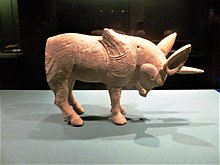
Pottery Unicorn. Northern Wei. Shaanxi History Museum
The qilin (Chinese: 麒麟), a creature in Chinese mythology, is sometimes called "the Chinese unicorn", and some ancient accounts describe a single horn as its defining feature. However, it is more accurately described as a hybrid animal that looks less unicorn than chimera, with the body of a deer, the head of a lion, green scales and a long forwardly-curved horn. The Japanese version (kirin) more closely resembles the Western unicorn, even though it is based on the Chinese qilin. The Quẻ Ly of Vietnamese myth, similarly sometimes mistranslated "unicorn" is a symbol of wealth and prosperity that made its first appearance during the Duong Dynasty, about 600 CE, to Emperor Duong Cao To, after a military victory which resulted in his conquest of Tây Nguyên. In November 2012 the History Institute of the DPRK Academy of Social Sciences, as well as the Korea News Service, reported that the Kiringul had been found, which is associated with a kirin ridden by King Dongmyeong of Goguryeo.[43][44]
Beginning in the Ming Dynasty, the qilin became associated with giraffes, after Zheng He's voyage to East Africa brought a pair of the long-necked animals and introduced them at court in Nanjing as qilin.[45] The resemblance to the qilin was noted in the giraffe's ossicones (bony protrusions from the skull resembling horns), graceful movements, and peaceful demeanor.[46]
Shanhaijing (117) also mentioned Bo-horse (Chinese: 駮馬; pinyin: bómǎ), a chimera horse with ox tail, single horn, white body, and its sound like person calling. The creature is lived at Honest-head Mountain. Guo Pu in his jiangfu said that Bo-horse able to walk on water. Another similar creature also mentioned in Shanhaijing (80) to live in Mount Winding-Centre as Bo (Chinese: 駮; pinyin: bó), but with black tail, tiger's teeth and claws, and also devour leopards and tigers.[47]



_001.jpg)


.svg)


.svg)


.jpg)


.jpg)